Collate Meaning: Simple Definition, Examples and Real Uses
Collate meaning explained simply: learn the definition, see real examples, printing and office uses, synonyms, and word-game scores. Read it now!
Ever been asked to collate a stack of papers and wondered what that really means? You’re not alone. Collate meaning goes beyond simple sorting, and the word shows up in offices, printers, and even word games.
In this guide, you’ll learn the simple definition, see examples, and discover how collating works with printing and documents. We’ll also cover synonyms and word-game scores, so you can use the term with confidence.
Collate Meaning: Simple Definition, Examples and Real Uses
Collate means to collect pieces of information, documents, or data and combine them in a proper order. In printing, it means arranging multiple copies page by page so each finished set is complete and in sequence. The word comes from the Latin collatus, meaning “brought together,” and it works as a verb.
Ever stared at a stack of loose pages and heard, “Please collate these”? Knowing the collate meaning saves time, whether you work in an office, print a school packet, or play word games. In our experience with multi-page documents, one small printer checkbox can turn a clean report into a pile of mixed-up pages. This guide covers the definition, origin, grammar, printing settings, and common mix-ups with collect, sort, and compile. By the end, you will use the word with confidence.
What Does Collate Exactly Mean?
Collate is a word people hear at work but rarely define. Here is the plain-English version, plus how the meaning shifts by setting.
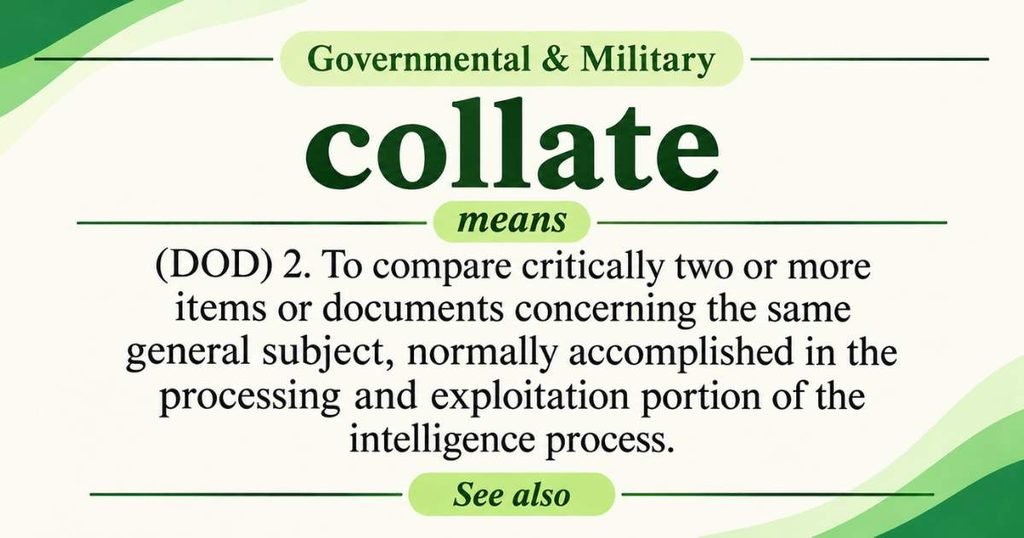
To collate means to gather separate pieces, put them in the correct order, and often check them against each other. The pieces can be pages, data, records, or even handwritten texts. The meaning of collate blends two ideas: bringing things together and arranging them properly.
Picture a teacher with 30 copies of a three-page handout. Collating means building 30 complete sets, each with page 1, page 2, and page 3 in order. Without that step, she has three tall piles and a lot of sorting ahead.
You will meet the word in several settings:
- Offices: assembling reports, contracts, and meeting packets
- Printing: arranging multiple copies page by page
- Research: combining data from different sources into one organized set
- Scholarship: comparing versions of a text to spot differences
- Publishing: checking that a book’s pages or sections run in sequence
The pronunciation is “kuh-LAYT,” with the stress on the second syllable. Remember the core idea: collating is more than collecting. It adds order and, often, a careful comparison.
Dictionary Meaning of Collate
Dictionaries agree on the core idea but list a few extra senses. Here is what you will typically find.
- Main sense: to collect and combine texts, information, or sets of figures in proper order.
- Printing and bookbinding: to assemble sheets or pages in the correct sequence, or to check that a book’s sections are complete.
- Scholarly use: to compare texts or manuscripts closely to note where they differ.
- Church history: to appoint a clergyman to a benefice. This sense is formal and rare today.
The word also has related forms: collated, collating, collation, and collator. Wording varies slightly between dictionaries, so check the one your school or workplace follows.
Word-game fans can play it, too. COLLATE is a valid Scrabble word, worth 9 points on its letters alone before any bonus squares.
Notice that the dictionary meaning always includes order. That is what makes collate different from simply piling things together. A pile is a collection, but a collated set is ready to use.
Origin and History of the Word “Collate”
Every word has a backstory. Collate’s story runs through Latin, medieval monasteries, and the early printing era.

Collate comes from the Latin collatus, the past participle of conferre, meaning “to bring together.” It entered English in the 1500s, when it meant to bring texts together and compare them. Scholars used it for checking one manuscript against another.
As printing grew, the word took on a practical meaning. Printers and bookbinders needed to gather sheets in the correct order, so “collate” expanded from comparing texts to arranging pages.
A related word has a gentler history. Collation can also mean a light meal. This is traditionally linked to the early Christian monk John Cassian, whose Collationes were read aloud in monasteries. The reading was followed by a small meal, and the word stuck.
Language never stands still. Collate has been around for roughly 500 years, while newer slang, such as the YOLO meaning many people look up today, is far younger. Both show how words shift to fit the way people live and work.
Is Collate a Verb or a Noun?
Grammar trips people up here, but the answer is short. Collate is a verb.
It is a transitive verb, so it needs an object: you collate something. Examples include “collate the reports” and “collate the results.” Its forms are:
- Collate: present tense (“I collate the files every Monday.”)
- Collated: past tense or adjective (“We handed out collated packets.”)
- Collating: ongoing action (“She is collating survey data.”)
The nouns come from the same root:
- Collation: the act or result of collating
- Collator: a person, or a machine, that collates
A common mistake is saying “the collate.” That is incorrect. Print menus label the setting “Collate,” which can look like a noun. It is still a verb used as a command, like “Print” or “Save.”
Examples of Using Collate In Sentences
Seeing the word in action makes it stick. These examples are grouped by setting.
At work
- “Please collate the survey responses into one spreadsheet by Friday.”
- “Our editor collated feedback from five reviewers into a single document.”
- “Could you collate the sign-in sheets after the event?”
At school
- “The assistant collated the handouts so every student received a full set.”
- “The committee collated everyone’s suggestions into one list.”
In research
- “She collated three years of sales figures to spot trends.”
- “Historians collated the two manuscripts to find where the scribes disagreed.”
- “He collated weather data from ten stations.”
With printing
- “Set the printer to collate, or you will get 50 copies of page one in a row.”
- “The librarian collated the pages of the damaged book to make sure none were missing.”
Notice the pattern. Each sentence includes several items plus a goal of order or comparison. If you are only picking something up, “collect” is the better word.
What Does Collate Mean When Printing?
This is the use most people search for. Here is how it works on a real printer.
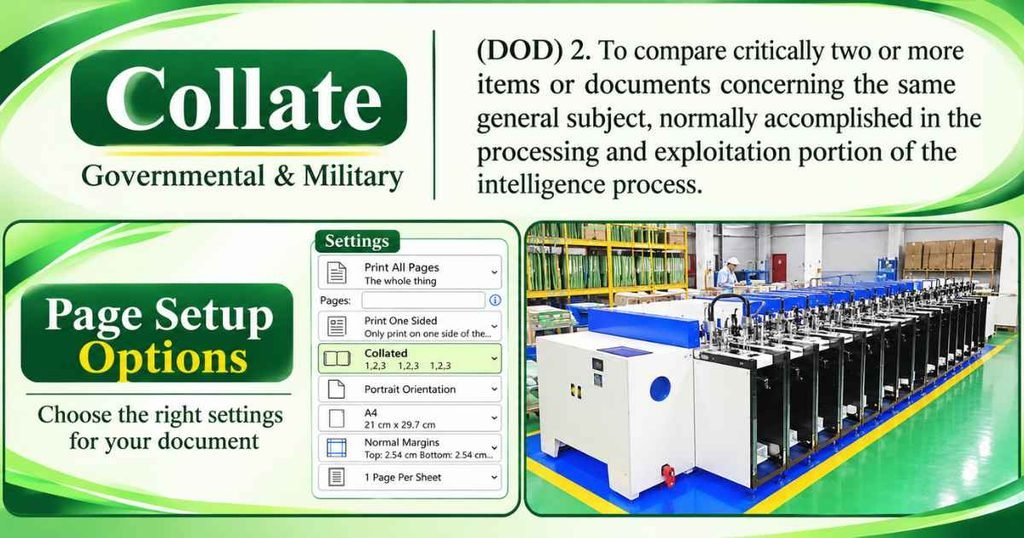
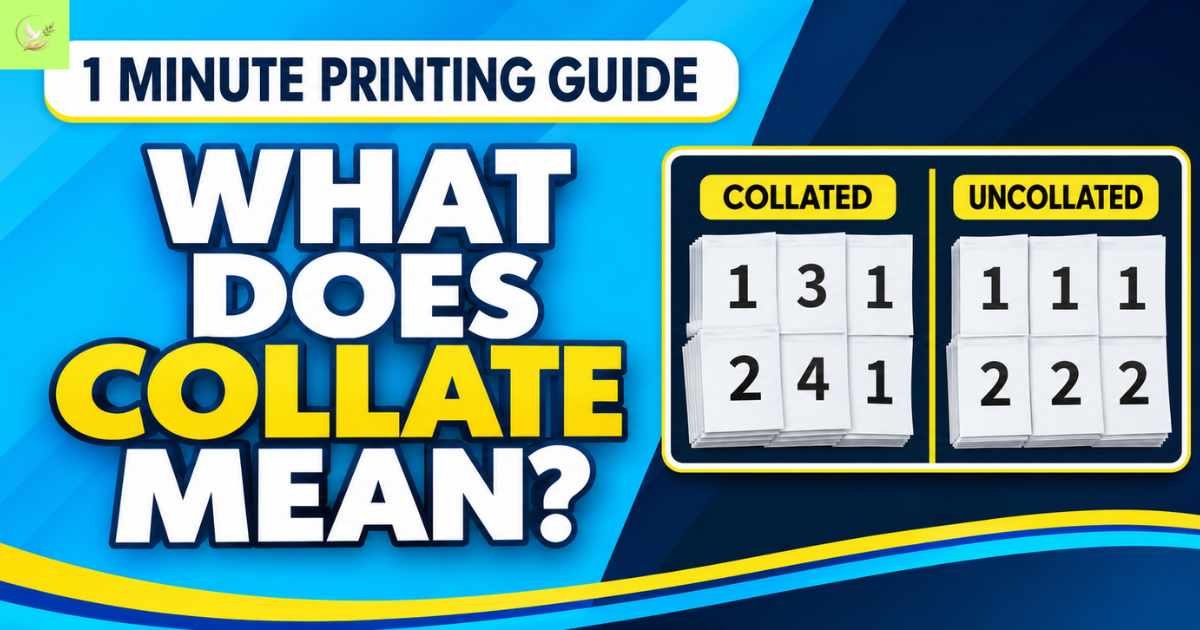
When you print several copies of a multi-page document, collating arranges each copy page by page. The printer finishes copy one in full, then copy two, then copy three. You can pick up each set and staple it right away.
For example, with a three-page document and three copies:
- Collated output: 1, 2, 3, 1, 2, 3, 1, 2, 3
- Uncollated output: 1, 1, 1, 2, 2, 2, 3, 3, 3
You will usually find the option as a “Collate” checkbox in the print dialog. Defaults vary by app and printer, so check the print preview before you send a big job.
Collating is most useful for:
- Handouts and meeting packets
- Contracts and proposals
- Manuals and booklets
It makes no difference when you print one copy or a single-page document. The setting only matters when there are multiple pages and multiple copies.
Collated vs Uncollated: What’s the Difference?
Both options print the same pages, but in a different order. Choosing the right one saves real effort.
| Feature | Collated | Uncollated |
| Page order (3 pages, 3 copies) | 1-2-3, 1-2-3, 1-2-3 | 1-1-1, 2-2-2, 3-3-3 |
| Result | Complete sets, ready to staple | Separate stacks of each page |
| Best for | Packets, reports, booklets | Flyers, worksheets, single pages |
| Extra work | Almost none | Hand-sorting into sets |
Use collated when each person needs a full document in order. This covers training packets, legal forms, and school handouts.
Use uncollated when you want stacks of identical pages. For example, you might print 100 copies of page one to hand out at stations, with page two for another group.
A simple rule works well: if the pages belong together in one set, collate. If each page goes somewhere different, leave it uncollated.
Collation in Business and Office Environments
Offices run on documents, so collation happens daily. Good collating keeps work organized and looks professional.
Common business uses include:
- Board and meeting packets: agendas, reports, and minutes in the right order
- Client proposals: cover page, pricing, and terms in sequence
- Training manuals: chapters assembled in the correct order
- Data reports: figures from several teams merged into one summary
Collating well protects you from simple but costly mistakes. A missing page in a contract or a swapped slide in a handout can confuse readers and waste time.
A few habits help:
- Number every page before printing.
- Add a cover sheet that lists what is included.
- Flip through one finished set before you print the rest.
Office reviewers also give quick feedback, and they often start comments with “tbh.” The TBH meaning is “to be honest,” and it shows up when someone points out a missing page or a messy packet.
Digital Collation vs Physical Collation
Collating is not only about paper anymore. Files and data now need the same careful ordering.
Physical collation deals with paper. You gather pages, sheets, or sections into a binder, booklet, or stapled set.
Digital collation deals with files and data. You merge several PDFs into one in the right order. You combine survey results into one spreadsheet. You pull records from different sources into a single table.
There is also a technical meaning. In databases, “collation” is the set of rules for how text is compared and sorted, including how it treats uppercase letters and accents.
| Physical | Digital | |
| Items | Pages, sheets, book sections | Files, rows, records |
| Tools | Printer, stapler, binder | Spreadsheet, PDF merger, database |
| Main risk | Missing or swapped pages | Duplicates and mismatched data |
Digital work can run while you step away. While a script collates data, you might be AFK, and the AFK meaning, “away from keyboard,” fits that moment well. Whatever the format, keep your original files and name everything consistently.
Collate vs Collect: Understanding the Difference
These two words sound alike and often appear together. They are not interchangeable.
To collect means to gather things from different places. To collate means to gather them and then arrange or compare them in a meaningful order.
Think of a survey:
- You collect the forms as people hand them in.
- You collate the answers into one organized table.
The first step only brings items together. The second step turns them into something useful.
A quick test works well. Ask yourself, “Did I put them in order or compare them?” If yes, you collated. If you only picked them up, you collected.
Here is how the sentences change:
- “She collected the permission slips.” (She picked them up.)
- “She collated the permission slips by grade.” (She arranged them by grade.)
Every collation includes some collecting, but collecting alone is not collating.
Collate vs Sort: Common Confusion Explained
Collate and sort overlap, which is why people mix them up. The difference comes down to scope and purpose.
To sort means to arrange items by a rule, such as alphabetical order, date, or size. You usually work with one set. To collate means to combine several sets or sources into one ordered whole, often checking them against each other.
For example:
- Sorting: putting a class list in A–Z order
- Collating: merging three class lists into one master list, in order, and checking for duplicates
Plenty of terms cause this kind of confusion. People look up the BDSM meaning for the same reason: a term is widely used but rarely explained clearly.
In practice, you often sort while you collate. The two actions work together, but they solve different problems. Sorting answers “in what order?” Collating answers “how do I bring these together and keep them in order?”
Collate meaning Compared With Similar Words
English has many words for gathering and organizing. Picking the right one makes your writing sharper.
Some words work like insider language, much like the IYKYK meaning, where only people in the know understand. Knowing the small differences below puts you in that group.
| Word | Meaning | How it differs from collate |
| Compile | Gather material into one work, such as a report | Compile focuses on creating the final piece; collate focuses on order |
| Assemble | Put parts together | Assemble stresses building, not checking order or comparing |
| Merge | Combine into one | Merge may ignore order |
| Organize | Arrange in a system | Organize is broader and does not require combining sources |
| Compare | Examine for similarities and differences | Compare does not combine anything |
Collate works as a good synonym for “gather in order.” A close alternative is “arrange in sequence.” When you also need to check for differences, collate is often the best fit.
Final Thoughts on Collate Meaning
The collate meaning is simple once you see the full picture. To collate is to gather items and arrange them in the right order, whether those items are printed pages, spreadsheet rows, or old manuscripts. It is a verb; it differs from collect, sort, and compile, and it matters whenever order matters. Next time you hit “print,” you will know exactly what that checkbox does. Bookmark this guide and share it with a colleague who still gets confused.
Frequently Asked Questions
What does collate mean in simple words?
Collate means to gather separate items and put them in the correct order. It can apply to papers, data, or texts, and it often includes checking items against each other.
What does collate mean when printing?
When printing several copies of a multi-page document, collate arranges each copy page by page. You get complete sets in order, such as 1-2-3, 1-2-3, instead of stacks of repeated pages.
What is the difference between collated and uncollated printing?
Collated printing outputs full sets in page order. Uncollated printing outputs all copies of page one, then all copies of page two, and so on, so you must sort the pages by hand.
Should I collate or not collate when printing?
Collate when each reader needs a complete document in order, such as a packet or contract. Skip it when you want separate stacks of identical pages, such as flyers or station handouts.
Is collate a verb or a noun?
Collate is a verb. The related nouns are collation (the act or result) and collator (the person or machine that collates).
What is the difference between collate and collect?
Collect means to gather items. Collate means to gather them and then arrange or compare them in a meaningful order. Collating always involves collecting, but collecting alone is not collating.
What is the difference between collate and sort?
Sorting arranges items by a rule, such as alphabetical order, usually within one set. Collating combines several sets or sources into one ordered whole, often checking for differences.
Where does the word collate come from?
It comes from the Latin collatus, the past participle of conferre, meaning “to bring together.” It entered English in the 1500s, first for comparing texts and later for arranging pages.
What does collate mean with digital files and data?
It means merging files, records, or results into one organized set, such as combining PDFs in order or pulling survey answers into one spreadsheet. In databases, collation also means the rules for comparing and sorting text.
What are some synonyms for collate?
Close synonyms and related words include compile, assemble, arrange, organize, and merge. None matches perfectly, since collate stresses gathering items in proper order, often with comparison.